
Pterygoid Dental Implants for Upper-Jaw Full-Arch Support
Pterygoid implants are placed in the dense bone at the back of the upper jaw. For selected patients, they may help support a full-arch restoration when conventional posterior implants are difficult to place. Candidacy is decided only after an exam and imaging.
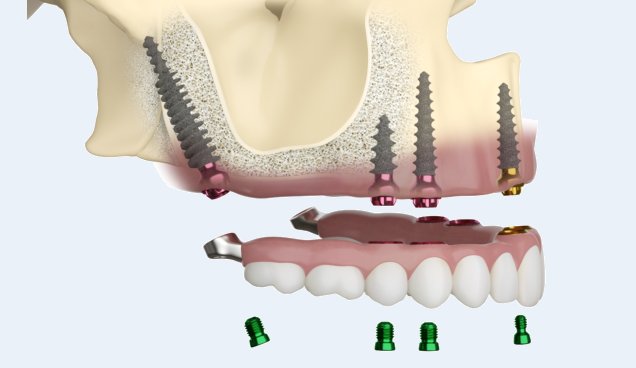
What Are Pterygoid Dental Implants?
A pterygoid implant is a dental implant placed in the back of the upper jaw, where the jawbone meets a bony area called the pterygoid region. This area often has denser bone than the section of the upper jaw just in front of it.
Pterygoid implants are an advanced option typically used as part of a full-arch plan, in combination with other implants, to give a fixed bridge more support in the back of the mouth.
How Pterygoid Implants Use Posterior Upper-Jaw Bone
In the back of the upper jaw, bone is often softer and thinner, and it can shrink after tooth loss. The sinuses can also sit close to the ridge, leaving little room for standard implants.
A pterygoid implant is angled backward and upward so that it engages the denser bone behind the upper molars. Like other implants, the bone gradually bonds to the implant surface during healing.
- Placement is planned on 3D imaging to reach suitable bone safely.
- The implant is typically angled, not straight vertical.
- It is usually combined with other implants in the same arch.
Why They May Be Used When Posterior Implants Are Difficult
Your doctor may discuss pterygoid implants if you have limited bone in the back of the upper jaw, sinuses that sit low, or a long-standing denture history that has led to bone loss.
They are not right for everyone. Your overall health, remaining bone, anatomy, and treatment goals determine whether this approach is appropriate.
Not suitable for every patient
Pterygoid implants have specific anatomical requirements and are a more technique-sensitive procedure. Your doctor may recommend a different approach after reviewing your imaging.
How Pterygoid Implants Can Support Full-Arch Restorations
A fixed full-arch bridge relies on well-placed implants spread across the arch. Adding support at the back can help the bridge extend further without relying on a long unsupported section.
In some plans, a pterygoid implant on each side is combined with implants in the front of the upper jaw to anchor a fixed set of teeth. The number and position of implants is always individualized.
Their Potential Role in Reducing Certain Grafting Procedures
Procedures such as a sinus lift add bone in the back of the upper jaw so conventional implants can be placed. They can be effective but may add healing time and cost.
For selected patients, using pterygoid bone may reduce the need for certain grafting procedures. This depends on your anatomy, and some patients will still need grafting or other preparation.
- Sinus lift followed by conventional posterior implants
- Angled implants positioned to avoid the sinus
- Pterygoid implants anchored in the back of the upper jaw
- Zygomatic implants anchored in the cheekbone
Treatment Planning and Recovery
Treatment starts with a consultation, an examination, and 3D imaging. If pterygoid implants may fit your needs, your doctor reviews the plan, benefits, risks, alternatives, and the estimated cost with you.
Recovery varies by patient. Swelling, soreness, and a soft diet are common early on, and your team will give personalized instructions. Bone needs time to bond with the implants, and the timing of final teeth depends on your case.
Surgical Risks and Limitations
Pterygoid implant placement is technique-sensitive because of the nearby anatomy. Your doctor will explain the risks that apply to you.
- Swelling, bruising, discomfort, or bleeding after surgery
- Bleeding or injury to nearby soft tissue or vessels
- Infection or inflammation around the implants
- Difficulty cleaning or accessing the back of the mouth
- Implant failure or the need for additional procedures
- Limited suitability for patients with certain anatomy or health conditions
When to call your dental office
Contact your treating office promptly if you notice fever, worsening pain or swelling, heavy or persistent bleeding, or anything that concerns you after surgery.
Pterygoid vs. Conventional Posterior Implants
| Consideration | Conventional implants | Pterygoid implants |
|---|---|---|
| Location | Back of the upper jaw ridge | Denser bone behind the upper molars (pterygoid region) |
| Typical use | Patients with enough posterior bone | Selected patients with limited posterior upper-jaw bone |
| Grafting | May need a sinus lift or graft | May reduce the need for certain grafts in selected cases |
| Surgical complexity | Lower in most cases | Higher, technique-sensitive |
| Candidacy | Determined by exam and imaging | Determined by exam and imaging; not suitable for everyone |
General comparison only. Your doctor determines the right approach for your anatomy and goals.
Continue Exploring
Zygomatic Implants
Cheekbone-anchored option for severe bone loss.
What Are Pterygoid Implants?
A patient-friendly explainer.
Implants Without Bone Grafting?
What may and may not be possible.
Why All-on-6
Our full-arch implant approach.
Office Locations
Oakton, Arlington and Manassas.
Dental Implant FAQ
More patient questions answered.
Find Out Whether Pterygoid Implants May Be an Option
Schedule a consultation for an exam and imaging so a doctor can review your bone, your goals, and all of your treatment options.
Ready to explore your options?
Find out if you may be a candidate — takes 60 seconds.